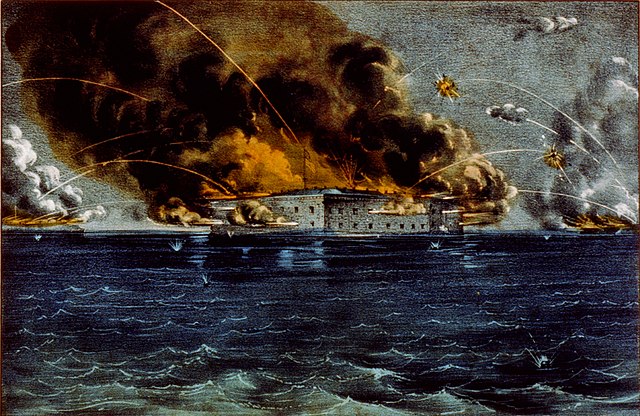
After a long, tense, and dull winter, the situation at Fort Sumter was dire on the morning of April 12, 1861. The harbor fort was incomplete and undermanned; rations of food and fuel were running low; and the artillerymen were surrounded by the soldiers of a rebellion determined to drive Federal forces from South Carolina. But relief was headed their way, if it would only arrive in time.
In the early days of the Civil War, the president of the United States found himself in a vexing situation: he wished to end the rebellion, but he could not legitimize the authority of the Confederate government by dealing with it directly. Formally intercoursing with the rebel government, even with the intention of ending it, risked the unintended effect of bolstering the perspective that the Confederacy was a government, with all of the rights and privileges entailed by sovereignty.
To complicate matters more, the rebellion had yet to turn violent.
In early April, Abraham Lincoln notified Francis Wilkenson Pickens, the governor of South Carolina of his intentions to resupply the fort, by force if necessary. The advanced notice was intended to be de-escalatory—if Southerners in Charleston awoke one morning to a Union convoy sailing into their waters, it might cause an unanticipated and rapid escalation in hostilities. The president knew that Pickens would dutifully keep the Confederate political and military leadership informed, removing from Lincoln the need to deal with the rebel government directly.
Upon learning of the Union resupply efforts, Jefferson Davis, president of the Confederate States of America, sent a dispatch to General Beauregard, the local confederate commander, ordering preemptive actions to prevent fresh supplies from reaching the fort:
If you have no doubt as to the authorized character of the agent who communicated to you the intention of the Washington Government to resupply Fort Sumter by force, you will at once demand its evacuation, and, if this is refused, proceed in such manner as you may determine to reduce it.
But on April 11 Major Robert Anderson, the Union commander at Fort Sumter, did refuse, and at 4:30 AM on April 12, Confederate lieutenant Henry S. Farley fired the first shot of the war upon the Federal fort. By 2:30 PM the next day, the fort surrendered. Thus the first battle ended without a single casualty, kicking off the bloodiest war in the history of the United States.
On April 19, less than a week after the fall of Fort Sumter, Lincoln issued a “Proclamation of Blockade Against Southern Ports,” setting the executive foundation for a comprehensive joint Navy-Army coastal campaign that lasted for the duration of the war:
Now, therefore, I, Abraham Lincoln, President of the United States . . . have further deemed it advisable to set on foot a blockade of the ports within the States aforesaid, in pursuance of the laws of the United States, and of the law of Nations, in such case provided. For this purpose a competent force will be posted so as to prevent entrance and exit of vessels from the ports aforesaid. If, therefore, with a view to violate such blockade, a vessel shall approach, or shall attempt to leave either of the said ports, she will be duly warned by the Commander of one of the blockading vessels, who will endorse on her register the fact and date of such warning, and if the same vessel shall again attempt to enter or leave the blockaded port, she will be captured and sent to the nearest convenient port, for such proceedings against her and her cargo as prize, as may be deemed advisable.
In a few sentences, Lincoln established an executive policy that would grow over the next four years into the largest endeavor ever undertaken by the United States navy. In addition to the numerous ships required, a successful blockade of the South relied upon greater logistical coordination than any previous U.S. naval campaign. From the commerce raiders of the Revolutionary War to the river boats and frigate duels of the War of 1812, no previous engagement had covered such a massive stretch of territory, and in the beginning the Union lacked the infrastructure of military doctrine to make the blockade a reality.
As Kevin Dougherty notes in his book Strangling the Confederacy, at the start of the war “the Federals had only Hampton Roads, Virginia, and Key West, Florida, available to them. These widely separated bases made it almost impossible to maintain an effective blockade.” Even in Hampton Roads, sea control was contested for the first year of the war. The strategic waterway near the mouth of the Chesapeake Bay was deep and navigable, surrounded by numerous peninsulas, harbors, and towns.
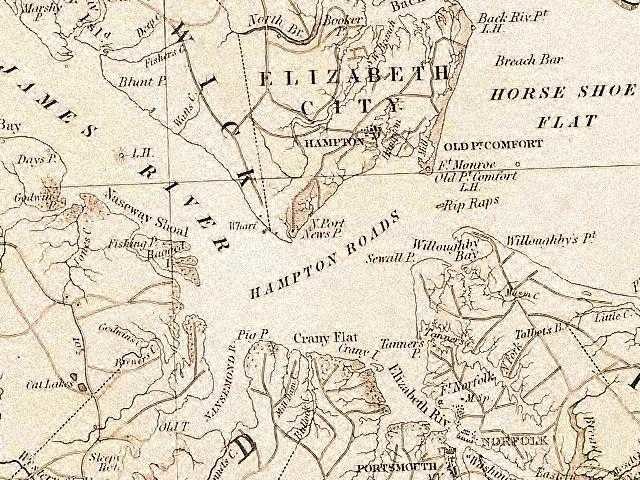
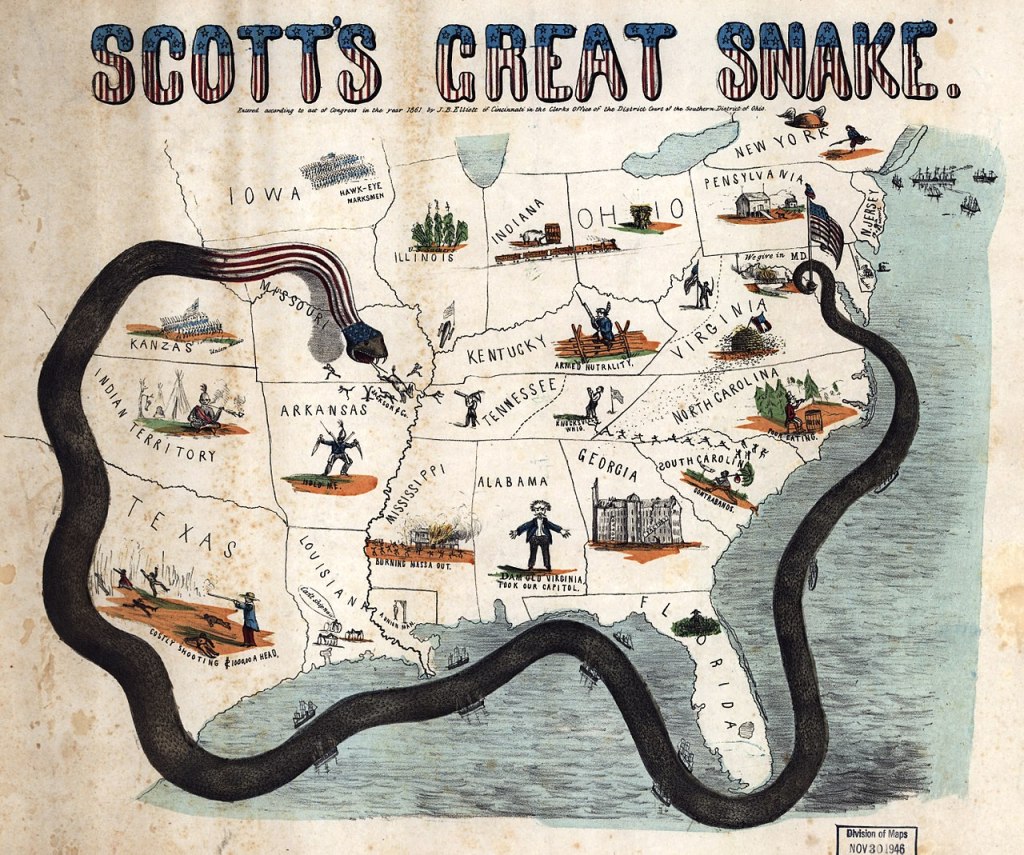
The Union held Fort Monroe on the Virginia Peninsula on the northern side of the water, but the more southern city of Norfolk and its Gosport Naval Yard was in the hands of the Confederacy after Union withdrawal from the city. The United States navy did not consolidate its control of the region until the spring 1862, more than a year after Lincoln proclaimed the blockade. The Union effort to strangle the Confederacy, now known as the Anaconda Plan, was shaping up to be more like a garden snake.
Lincoln’s proclamation included an additional provision, one which was to cause much anger among southerners throughout the war. Jefferson Davis had announced a few days earlier that the Confederacy would issue Letters of Marque, authorizing letter holders to act as privateers against United States commerce at sea. The April 19 proclamation contained the Union’s response:
And I hereby proclaim and declare that if any person, under the pretended authority of the said States, or under any other pretense, shall molest a vessel of the United States, or the persons or cargo on board of her, such person will be held amenable to the laws of the United States for the prevention and punishment of piracy.
The Union campaign against southern commerce raiding became a worldwide battle that began earlier and lasted longer than the more famous ground campaigns of the war.
Piracy was a capital offensive, and those convicted of it could be subject to death by hanging. The brutality of such a proclamation was not lost on Confederate leadership, nor was the (at the time) logistical impossibility of enforcing a blockade. In a lengthy April 29 address to the provisional congress of the Confederate States of America, Jefferson Davis vigorously defended the Confederacy’s legitimacy as a government by presenting a “review of the acts of the Government of the United States.” He argued that the “Northern mind” had an improper understanding of the constitution and the relationship between the states and the federal government. He endorsed the institution of slavery and condemned the Northern states for attempting to limit its spread. The entire address listed out numerous grievances that the Confederacy lodged against the United States. In the midst of this, near the end of the address, Davis replied directly to the April 19 proclamation:
[Congress] will concur with me that it is hard to believe [Lincoln’s proclamation] could have emanated from a President of the United States. Its announcement of a mere paper blockade is so manifestly a violation of the law of nations that it would seem incredible that it could have been issued by authority; but conceding this to be the case so far as the Executive is concerned, it will be difficult to satisfy the people of these States that their late confederates will sanction its declarations—will determine to ignore the usages of civilized nations, and will inaugurate a war of extermination on both sides by treating as pirates open enemies acting under the authority of commissions issued by an organized government. If such proclamation was issued, it could only have been published under the sudden influence of passion, and we may rest assured mankind will be spared the horrors of the conflict it seems to invite.
The April 19 proclamation and its implications left a deep impression upon the young Confederacy, so deep that it was a grievance worth mentioning in the same document that defended the South’s peculiar institution. At the time though, ten days after it was signed, there was no force behind the provisions contained therein. Unknown to Davis, the Union was busy making the necessary preparations to turn its “mere paper blockade” into a reality which would be felt throughout the South, in every household that relied upon imports for its comfort and continued existence.
This is the first in a series of posts about the Naval Campaigns of the American Civil War.


Leave a Reply