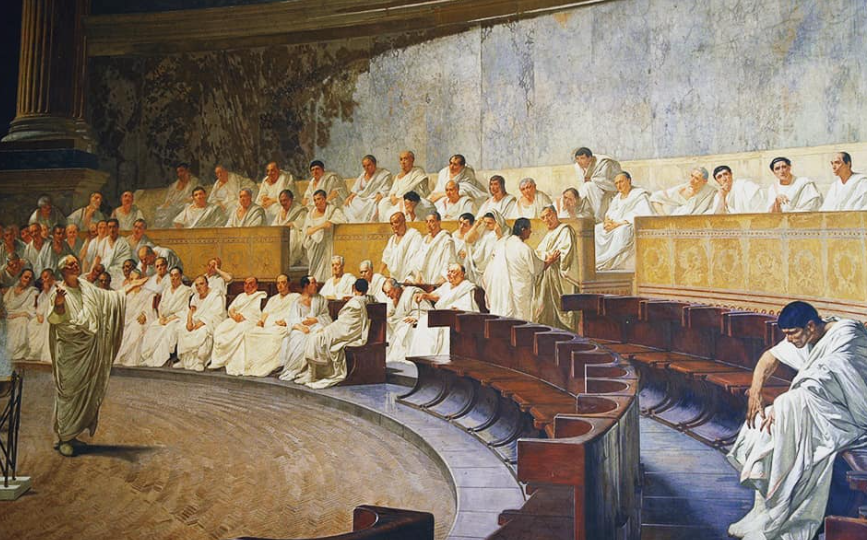
“[A]ll ages of the world have not produced a greater statesman and philosopher combined.”
John Adams
Marcus Tullius Cicero (106-43 B.C.) was one of the greatest lawyers, orators, statesmen, and philosophers that the Roman Republic had ever seen. From humble beginnings in Arpinum some seventy miles south of Rome, to advocate at the Roman bar, Cicero defended the Roman constitution with an unwavering spirit the likes of which were not matched.
His writings were read by and influenced the likes of Saint Jerome, Petrarch, and the American Founding Fathers. John Adams wrote of Cicero in his Defence of Constitutions that “all ages of the world have not produced a greater statesman and philosopher combined.”

In 75 B.C., Cicero served as quaestor in Sicily where he prosecuted and obtained a conviction against then governor, Gaius Verres, for extorting the people of the province. As consul in 63 B.C., Cicero put down a conspiracy by Lucius Sergius Catilina to overthrow the Republic and drove the conspirators out of the city after delivering the scathing Catalina Orations. Later in his life, he wrote treatises on numerous subjects including De re publica (On the State), De officiis (On Duties), and De finibus bonorum et malorum (On Supreme Good and Evil).
For all his contributions to law, politics, & philosophy, Cicero was also a man like any other, with his own flaws. He was often cold and distant with his first wife, Terrentia. His son Marcus, did not possess his father’s intellectual abilities and lived in his shadow. Stability came in the form of his daughter Tullia and his friend Atticus.
Cicero in weighing the decision to join the First Triumvirate or not, wrote to Atticus that he “must always find one omen best: to fight for fatherland.” This dedication to the Roman constitution was eventually his downfall. In 43 B.C. he was proscribed and executed by the Second Triumvirate.
Plutarch in his Life of Cicero told an anecdote where an aging Augustus catches his grandson reading a book of Cicero’s. The grandson tries to hide it, but Augustus takes it from him, reads the words, and says of there author: “an eloquent man, my child, an eloquent man, and a patriot.”
Cicero
 HistoryBros
Leave a comment