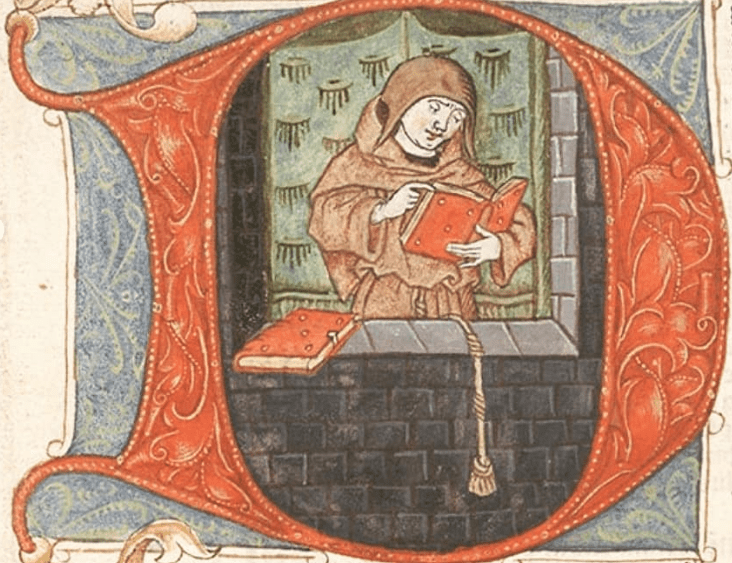
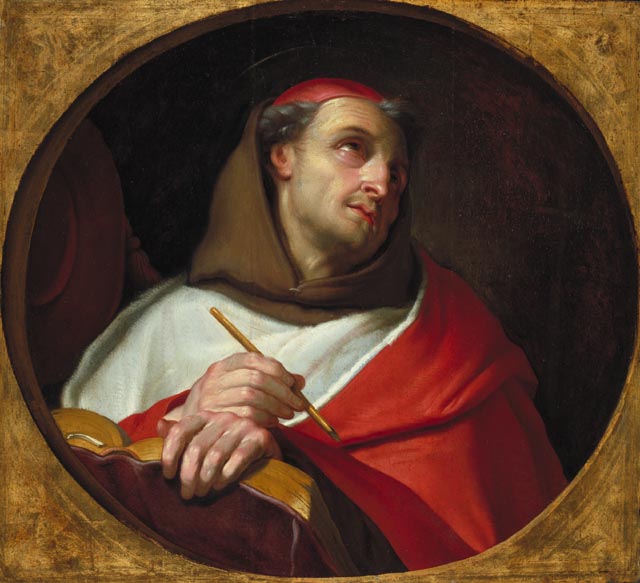
Saint Bonaventure was born in the Papal states in 1221, and little is known about his early life. He was a contemporary of the most influential thinkers of the time, including Saint Thomas Aquinas, Alexander of Hales, and Saint Albertus Magnus. Bonaventure served as the seventh Minister General of the Franciscan Order, a position he held at the young age of 37. The saint was also something of a historian himself, having authored The Life of Saint Francis of Assisi, a biography on the founder of his order. He completed his studies at the University of Paris around the same time as Saint Thomas Aquinas.
“[W]hen representatives from the Pope arrived to give him his mitre . . . he was busy washing dishes and asked them to hang it on a tree until he finished.”
His philosophy incorporated mysticism with academic rigor, with him describing the material world as “a ladder for ascending to God.” During his life he was elevated to the College of Cardinals by Pope Gregory X though he seemed to have preferred a quiet life of labor and contemplation than the life of a Cardinal in the tumultuous 1200s. Stories say that when representatives from the Pope arrived to give him his mitre, the sign of his appointment as a Cardinal, he was busy washing dishes and asked them to hang it on a tree until he finished. He personally worked for the pope at the 1274 Council of Lyons and while there, he succumbed to a sudden illness, which some records claim to have been caused by a poison.
After his death, his cause for canonization sprung up almost immediately, as he was one of the most highly respected and beloved Medieval philosophers. Dante’s Divine Comedy places Bonaventure in Paradise almost two centuries before his canonization by Pope Sixtus IV in 1482.
His relics were later revealed to be incorrupt but were tragically lost during the Huguenots’ pillaging of his shrine and the French Revolution. The Seraphic Doctor’s writings include original treatises and elaborate commentaries on both philosophic texts and Scripture.
He is known for his influential work incorporating Aristotelian principles with the neo-Platonic understanding of the Forms. Bonaventure sought to reconcile these antagonistic perspectives, arguing that Plato’s conception of Forms was a pagan attempt to grapple with the role of God in a fallen world. To the neo-Platonic Christian, forms don’t exist as an ideal reality, rather, they exist in the “mind of God,” and our world is unable to replicate those forms due to our own sinfulness.
Bonaventure
 HistoryBros
Leave a comment